
This Parallax is Personal
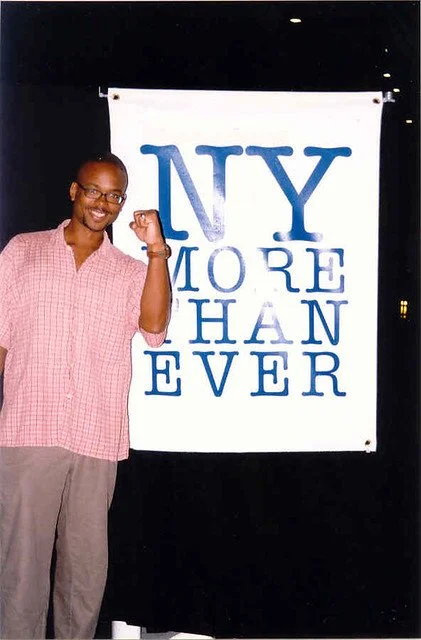
Everett in Barcelona, La Raval neighborhood, in Sept 2001 after the 9/11 attacks. Banner created in support of NYC
25 years ago, sitting in a late-night cafe in Barceloneta, I journaled about how I would return to San Francisco in a month. Everyone I knew would be carrying the same trauma, reflexively cringing with each low flying plane. But I was 4000 miles away on Sept 11, 2001, trying to make sense of what I’d just witnessed. I wrote that it would feel like arriving at a funeral just as the last cars pulled out of the cemetery.
That day, I'd taken the day off from my Spanish immersion program, speaking virtually no English. I’d had a five day headache from the strain, so I was looking forward to thinking in my own language for a few hours.
I passed a bar, French doors wide open, and a motionless crowd standing in front of it, staring inside. I heard English television coming from inside, and had an immediate, vivid image: The last time I'd seen gathered strangers watching in silence was the day Princess Diana died.
I walked in. What I saw looked like a disaster movie, badly staged. It took a full minute to understand I wasn't watching a movie. It was immediately personal. I knew people who worked in the towers, including my classmate who died in the attack. My brother lived in NYC (and was supposed to be in the building that morning but forgot his briefcase). There were rumors of more planes, more buildings. I was stunned, helpless, and disconnected from the suffering of people I knew.
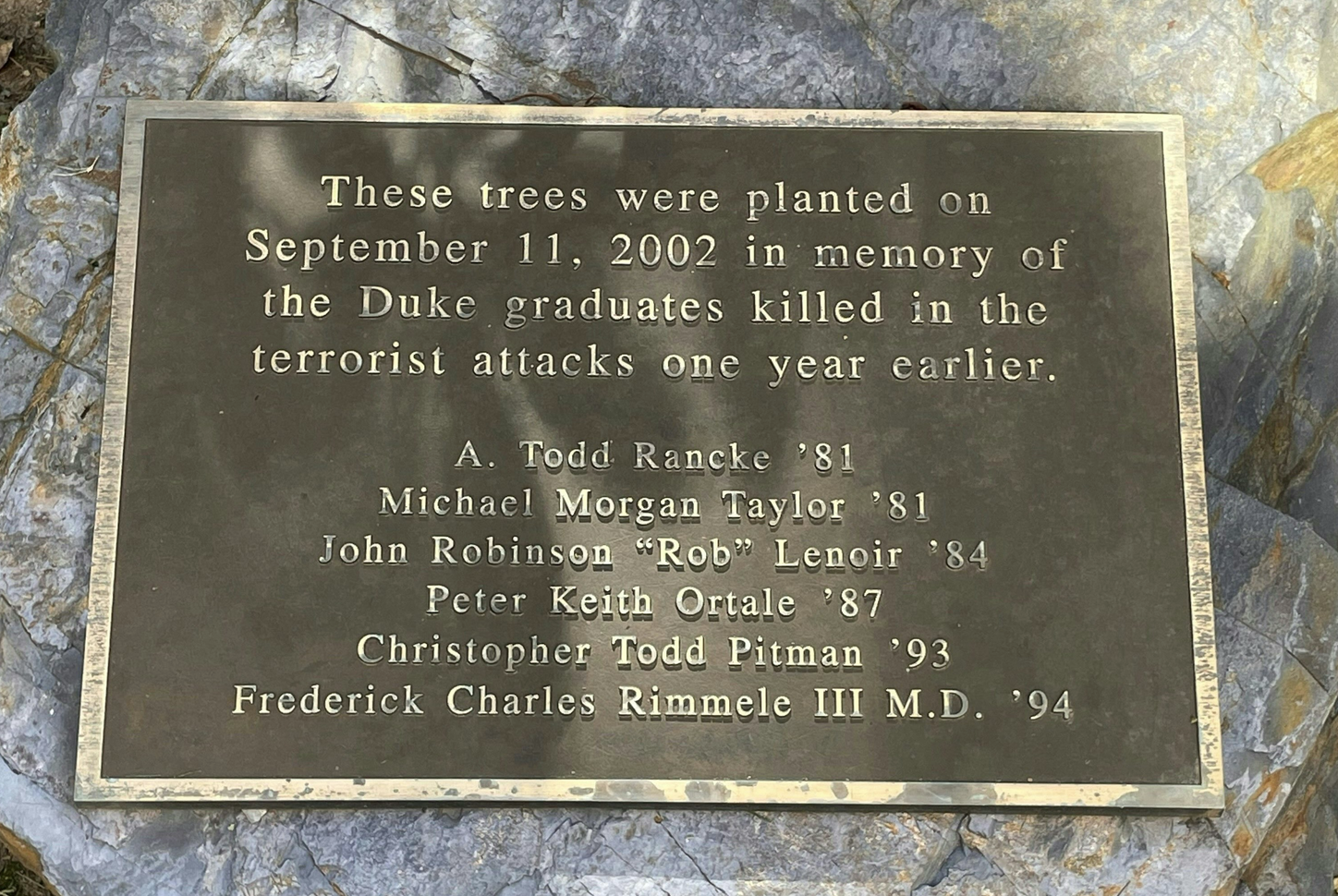
Memorial Plaque for Duke University alumni victims of 9/11 Attack. (Credit: Duke University Alumni Association)
I confirmed that my immediate family and closest friends were safe in the next 24 hours. Then, for the next few days, I consumed everything I could, switching between CNN US, CNN Europe, and El País, trying to make sense of it in two different languages, and realizing how differently the stories were being told.
American coverage was raw, anchored in trauma. Personal stories, grief, miraculous survivals and the search for the responsible parties. All soaked in the shock of terror on US soil at that scale for the first time in most people's living memory. The European coverage was more analytical. The attack was inside a longer thread of terror and war on European ground, from the IRA to ETA, civil wars and two world wars.
Four weeks later, I was back in the Mission District of San Francisco. Everyone around me had their story: where they were, who they couldn't reach, people they had lost, the trauma of the hour-by-hour coverage. The fact of the loss was the same for all of us. The experience of it was not. It took our collective storytelling to bring healing and clarity, and arriving late meant I had to find my way to contribute to that memory from the outside.
These were two vivid experiences of what I later call parallax. Multiple, partial positions, shaped by distinct histories and personal experiences. And the gap between two honest views of the same event often holds more truth than either view alone.
I think about that gap a lot now, in the work I do on resilience, polycrisis, and how organizations make decisions under pressure and uncertainty. The 25th anniversary of 9/11 reminded me that this parallax is personal.
For the families, rescue workers, and residents who suffered on that terrible day, my respect and condolences. My hope is that we, as groups and organizations, can start holding multiple parallax perspectives long enough to realize that these gaps might be the key to preventing disasters like this in the future.